What's a good reading speed? The real average, in words per minute
The average adult reads about 238 to 260 words a minute. Here's where that number comes from, how it breaks down by age, and how to time your own.
Search “average reading speed” and you will get a different number on every page. Two hundred. Three hundred. One site insists the real figure is 400, another quotes 900 and calls it modest. None of them say where the number came from, which is usually a sign nobody checked.
The number that actually has a source behind it is 238 words per minute for silent nonfiction reading, and 260 for fiction. That comes from a 2019 meta-analysis by Marc Brysbaert covering 190 studies and more than 18,000 readers, the largest review of reading rate research that exists.1 If you read English silently, as an adult, at a typical pace, you are probably within shouting distance of that range. Most adults land somewhere between 175 and 320 words per minute depending on the text and how tired they are.
That range is the honest answer. The more useful question is what to do with it.
Why the number moves around so much
Reading rate is not a fixed trait, the way height is. It is a measurement of a specific act of reading, and every part of that act changes the result. Fiction reads faster than nonfiction because the sentences are shorter and the vocabulary is more familiar. Reading aloud is slower than reading silently, dropping to around 183 words per minute, because your mouth is now the bottleneck instead of your eyes.1 A screen reads slightly slower than a page for most people. A textbook chapter on a subject you already know reads faster than one you don’t, regardless of how fast you technically read.
None of the online quizzes that hand you a number control for any of this. They show you a paragraph, start a timer, and stop it when you click a button, with no check on whether you actually understood what you read. That is how a site ends up telling someone they read at 900 words a minute. At that pace you are not reading in the sense that produces retained meaning. You are pattern-matching down a page and calling it comprehension because nothing stopped you. The research on this is unambiguous: pushing well past the 300 to 400 range on unfamiliar material costs you understanding faster than it gains you time.2 A test that only measures speed will always reward skimming over reading, because skimming is faster and the test cannot tell the difference.
How it breaks down by reader
A few reference points, none of them a verdict on anyone’s reading ability:
Children. Oral reading fluency, which is what schools actually measure, climbs steadily through elementary school. National norms put the typical spring rate at 60 words per minute in first grade, 100 in second grade, 112 in third, and roughly 146 by fifth and sixth grade.3 This is reading aloud, not silent reading, so it is not directly comparable to the adult figures above, but the trend line matters more than any single number: fluency is a skill that builds year over year, the same way it does for an adult building a daily habit.
Adults on easy material. Comfortable, familiar fiction, the kind you read for pleasure rather than to extract information, tends to land at the high end of the adult range or slightly above it.
Adults on hard material. Dense nonfiction, technical writing, or anything in a second language pulls the number down, sometimes well under 200. This is not a sign you are a slow reader. It is a sign the material is doing what it is supposed to do, which is make you think.
Older adults. Reading speed declines modestly after 65, mostly tracking vision changes rather than any drop in comprehension or processing speed.
The spread across all of this is wide enough that a single “good” number does not really exist. A good reading speed is one that lets you finish what you started with most of it still in your head a week later.
Testing your own, without a website
You do not need a browser quiz to find your own number, and a homemade version will be more honest than most of the ones online, because you can check comprehension yourself.
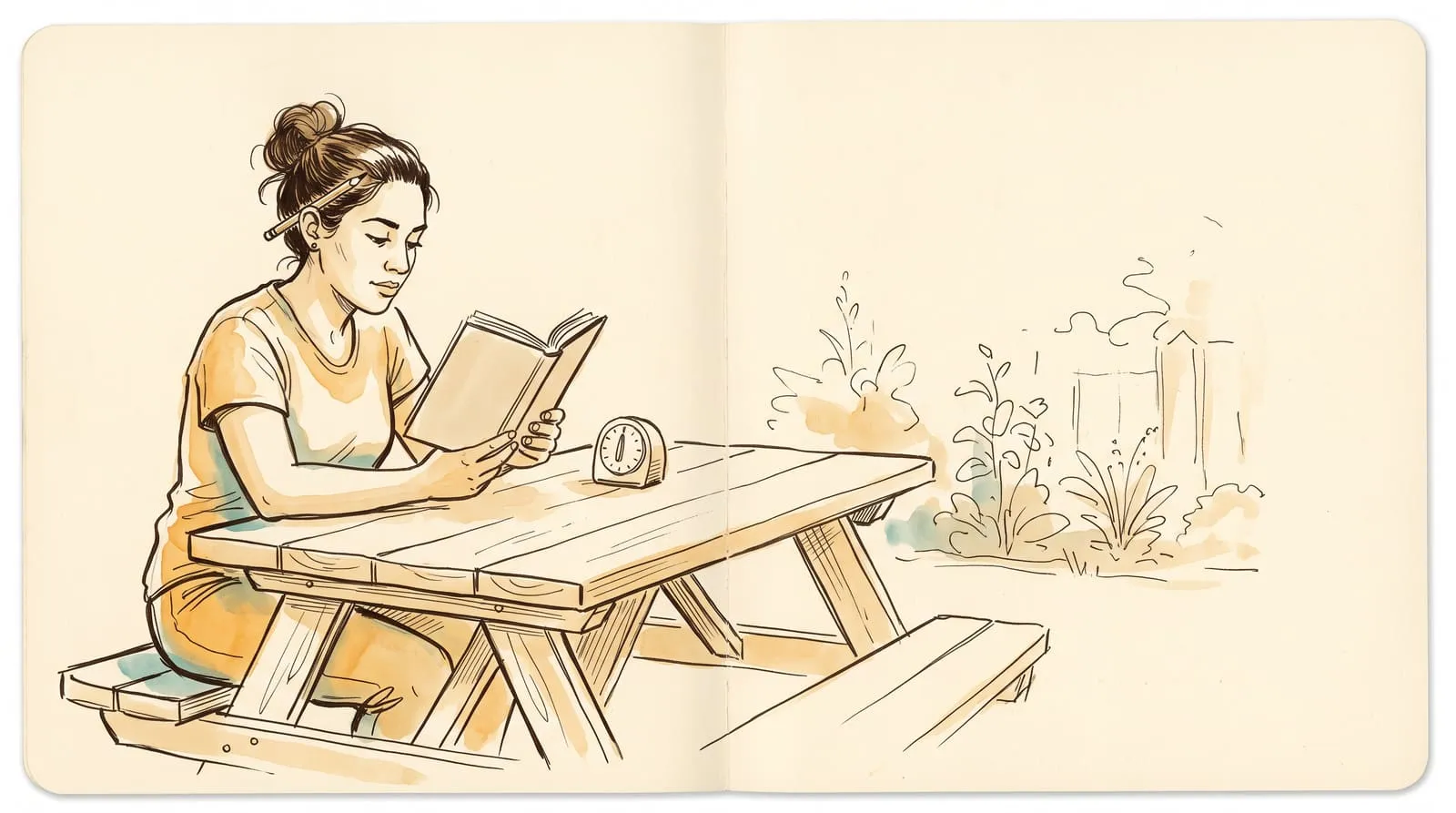
Pick something you have not read before, ideally a book rather than an excerpt, since excerpts skew easy. Read for exactly three minutes at a normal pace, the pace you would use if nobody were timing you. Mark where you stopped. Count the words on two or three full lines, average them, multiply by the number of lines you covered, divide by three. That is your words per minute for that text, on that day, in that mood.
Then do the part the online tests skip. Close the book and say out loud what happened in the section you just read. If you can do that in real detail, the number is meaningful. If you are reconstructing it from vague impressions, you were skimming, and the number is inflated in a way that will not survive a real book. Whether reading faster actually gets you through more books turns out to depend far less on this number than most people assume, for reasons that have more to do with how often you sit down to read than how fast you move once you do.
What to do with the number once you have it
Mostly, nothing dramatic. Reading speed is one input into how long a book takes. Run the same 238-to-260 range forward against an actual book length and you get how long it takes to read a book, which is the more concrete question most people are really asking. If you want the arithmetic pointed the other direction, how many pages you need to read a day to hit 50 books a year uses the same figures to work out a daily target, and it holds up whether your personal rate is 200 or 280.
The one thing worth doing with a low number, if yours comes in low, is checking whether the text is actually the problem before assuming you are. A 190 words-per-minute pace on a dense academic chapter is not evidence of anything except that dense academic chapters are dense. The same reader will likely clear 260 on the novel sitting next to it.
A note on what Moth shows you
Moth calculates reading speed automatically from your session logs, pages divided by minutes, no separate test required. Because it comes from real reading rather than a timed paragraph, it tends to track the comprehension-checked number rather than the skimmed one, and it moves around by book the way the research above predicts it should: faster on the novel, slower on the nonfiction you picked up to actually learn something.
If you want to see your own number without opening a browser tab, start a session tonight and read for ten minutes at whatever pace feels normal. The figure that comes back afterward will tell you more than any quiz that grades you on speed alone.
Footnotes
-
Brysbaert, M. (2019). How many words do we read per minute? A review and meta-analysis of reading rate. Journal of Memory and Language, 109, 104047. https://doi.org/10.1016/j.jml.2019.104047 ↩ ↩2
-
Rayner, K., Schotter, E. R., Masson, M. E. J., Potter, M. C., & Treiman, R. (2016). So much to read, so little time: How do we read, and can speed reading help? Psychological Science in the Public Interest, 17(1), 4-34. https://journals.sagepub.com/doi/10.1177/1529100615623267 ↩
-
Hasbrouck, J., & Tindal, G. (2017). Oral reading fluency norms (2017 update). Reading Rockets. https://www.readingrockets.org/topics/fluency/articles/fluency-norms-chart-2017-update ↩