Best reading tracker apps for iPhone (2026)
Moth, StoryGraph, Bookly, Goodreads, and Fable compared on design, stats, privacy, price, and habit-building. Find the right one for how you actually read.

Pick up most reading tracker roundups and the winner goes to whichever app has the most features. That framing works if you want a book database. It completely misses the actual question most people are asking: which of these apps is most likely to make me open my book tonight?
The five strongest reading tracker apps on iPhone in 2026 take genuinely different positions on that question. Moth, StoryGraph, Bookly, Goodreads, and Fable each represent a different theory of the problem. Some are habit tools. Some are library catalogs. Some are social networks that happen to let you log books. Downloading the wrong one is extremely common, and it’s why so many people cycle through three or four of these without any of them sticking.
We spent several weeks with all five apps. This is the full comparison: what each one does well, where each one falls short, and who each one is actually built for.
The five best reading tracker apps for iPhone: at a glance
| Moth | StoryGraph | Bookly | Goodreads | Fable | |
|---|---|---|---|---|---|
| Platform | iOS, Android | iOS, Android | iOS, Android | iOS, Android | iOS, Android |
| Free tier | Up to 12 books | Unlimited (most features) | Up to 10 books, ads shown | Fully free | Unlimited books |
| Paid price | $4.99/mo or $24.99/yr | $4.99/mo or $49.99/yr | $4.99/mo · $19.99/6mo · $29.99/yr | Free | $5.99/mo or $49.99/yr |
| Reading timer | Yes, core feature | No | Yes, core feature | No | No |
| Streaks | Yes, with milestone cards | Yes | Yes | No | Yes |
| Stats and analytics | Premium; reading speed, session history, trends | Free; charts by mood, pace, genre, length | Solid; per-book infographics, monthly and yearly reports | Basic; annual book-count challenge only | Free; most-read authors, genres, longest streak |
| Social features | None | Friends, buddy reads, book clubs | None | Friends, reviews, groups (central to the app) | Book clubs (central to the app) |
| Shareable cards | Completion cards and streak milestones | No | Per-book infographic | No | Monthly and annual Reading Wraps |
| Privacy | Private by default | Independent; no Amazon, no ads | iCloud sync; tracks device ID for ads | Amazon-owned; extensive data collection linked to identity | VC-backed; tracks device ID across apps |
| Best for | Building a daily reading habit | Understanding your reading patterns | Cross-platform timer tracking | Readers already embedded in the Goodreads community | Social reading and book clubs |
Moth
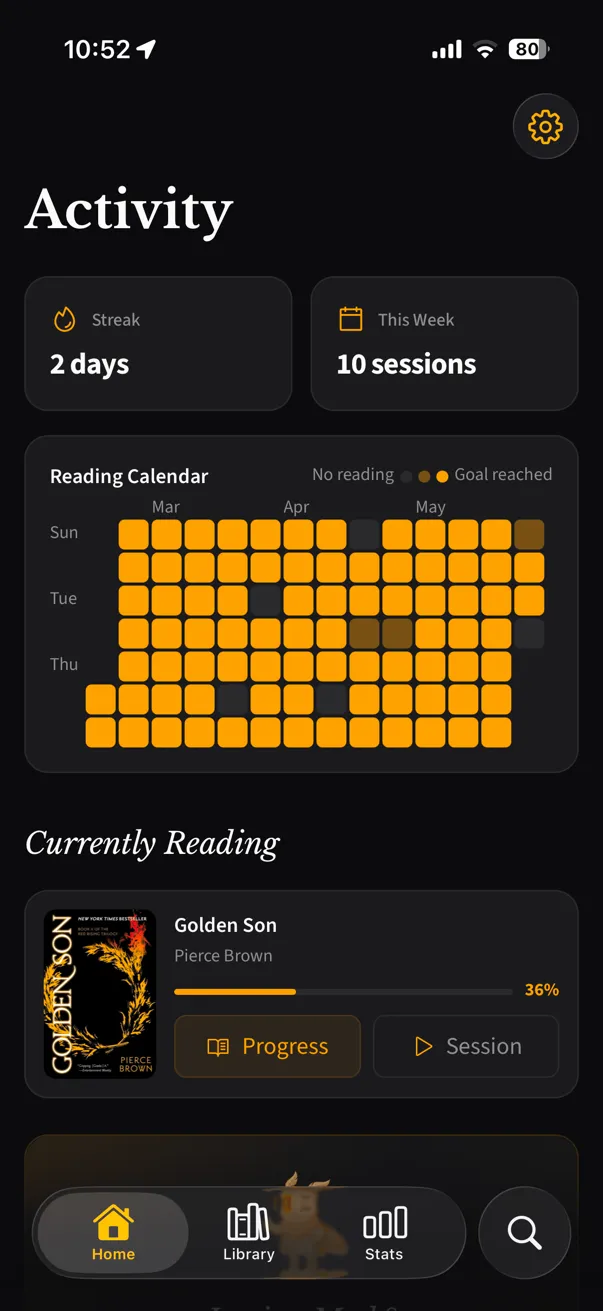
Moth is built around a specific conviction: reading habits form when daily sessions get rewarded, not when books get finished. That premise shapes everything the app does, from what it shows on the home screen to what it sends you on Sunday evenings.
The center of the experience is a reading timer. Tap start when you open your book. Tap stop when you put it down. Moth records the time, calculates your reading speed from the page numbers you enter, and logs the session without asking for anything else. The deliberate simplicity matters more than it might seem on a spec sheet, because one extra tap is often the difference between using an app consistently and abandoning it.
The daily goal is set in minutes or pages. Ten minutes is the suggested starting point, and that recommendation is made carefully. Ten minutes is achievable on any day, including the ones when you’re tired, distracted, or only have twenty minutes before bed. Missing a streak at day 30 hurts considerably more than missing one at day two, so starting with a target you can actually hit every night is more important than setting one that sounds impressive.
Streak tracking is where Moth’s design becomes most specific. Milestone animations trigger at 7, 14, 30, 50, and 100 days. Every Sunday, a weekly wrap arrives in the app: pages read, time logged, streak status, and a reading speed trend for the week. It lands at the moment when you might naturally be thinking about the week ahead, without requiring you to go looking for it.
Completion cards work on the same principle. When you finish a book, Moth generates a 9:16 portrait card with cover art, your rating, and your session statistics, formatted for Instagram Stories and BookTok. Most reading apps let you mark a book finished. Moth makes the moment specific enough to be worth sharing.
The design is dark-mode-first. Warm backgrounds, amber accents, sparse layout. The practical reason: most people read at night, and an interface that doesn’t work against low-light conditions earns its keep.
The free tier includes library tracking, unlimited reading sessions, daily goal and streak tracking, and up to 12 books, which is a genuinely usable free limit rather than a demonstration mode. Premium unlocks unlimited book tracking, full reading statistics, and yearly goal tracking. The statistics are the strongest reason to upgrade: reading speed over time, session length trends, and historical data going back as far as you’ve been using the app. For readers who want to understand whether their reading pace actually improves with consistent sessions (it does, for most people), the stats tell that story concretely.
If your goal is building a daily reading habit, this is where we’d start. We wrote more about the habit formation mechanics in our guide to the 66-day rule if you want the research behind why daily sessions work better than chapter-count goals.
StoryGraph
StoryGraph reached 5 million user signups in January 2026. Most of those users arrived from Goodreads, looking for something with better data and no Amazon. What they found was the most statistically capable book tracking app available on any platform, and the 2025 iPad App of the Year winner at Apple’s App Store Awards.
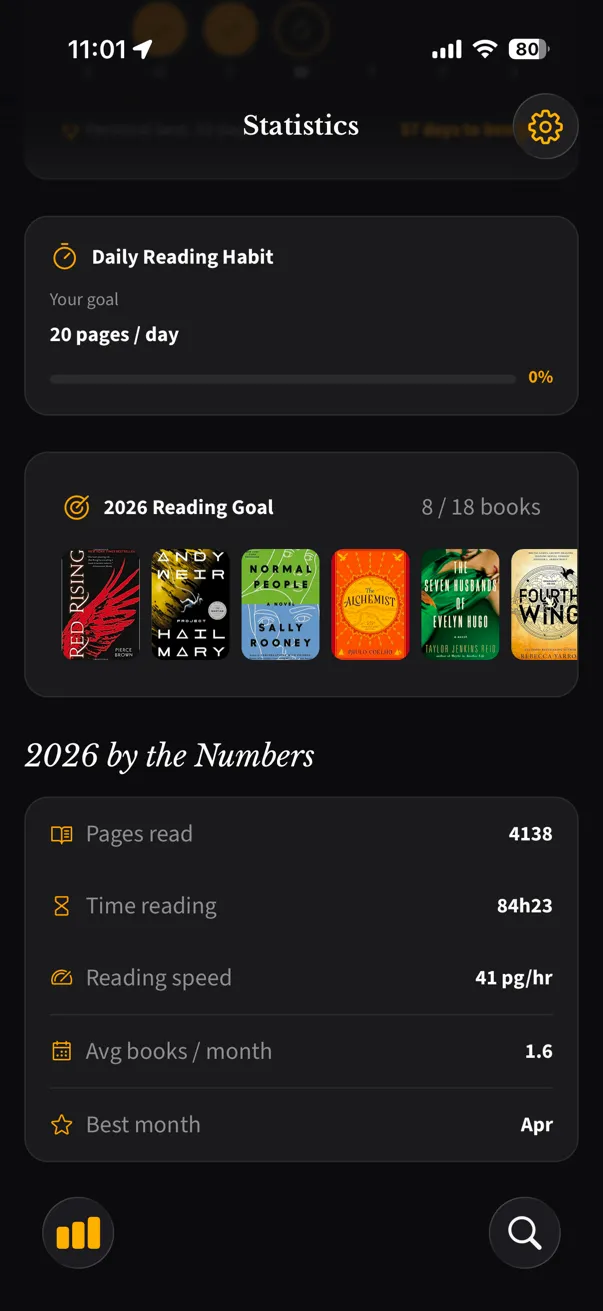
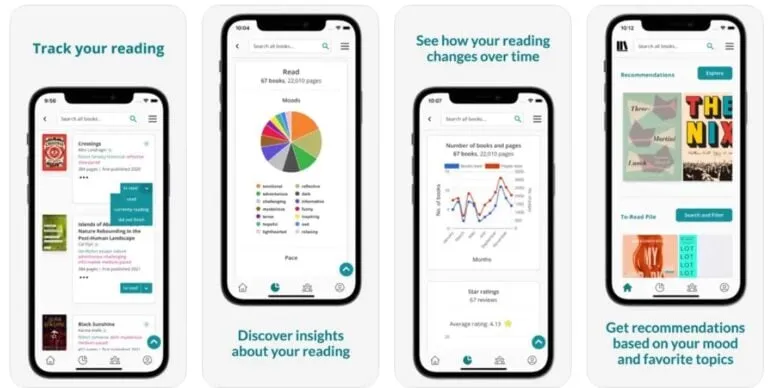
The premise is that reading data should be richer than a shelf and a star rating. When you log a book on StoryGraph, you categorize it by mood (adventurous, dark, hopeful, mysterious, tense, and several others), pace, and whether it’s more plot-driven or character-driven. Over enough books, those tags produce genuinely useful patterns. You might find you consistently give lower ratings to books you read faster. Or that your reading pace slows in February every year. These are real signals that are invisible in apps that only track titles and dates.
The statistics are deep and most of them are free. Charts show genre distribution over time, average rating by format, reading pace history, and pages per month going back to whenever you started. The app also tracks streaks and hosts reading challenges, buddy reads, and book clubs. The Plus subscription ($4.99 per month or $49.99 per year) adds custom charts, extra stat filters covering any date range or genre, shareable wrap-up graphics, and the ability to compare any two segments of your library against each other. The free tier already contains more analytical depth than most trackers charge for. A one-time Goodreads import brings your entire reading history across with it, custom shelves and all.
What StoryGraph doesn’t have is a session timer. The app knows when you started a book and when you finished it, but it has no record of how long you spent reading on a given Tuesday evening. For readers primarily interested in cataloging and analyzing their reading, that’s an acceptable trade. For readers trying to build a daily practice, the absence of session tracking removes the most direct signal that the habit is forming. StoryGraph is the best app available for understanding your reading patterns over time. As a tool for changing them, it has limits.
Bookly
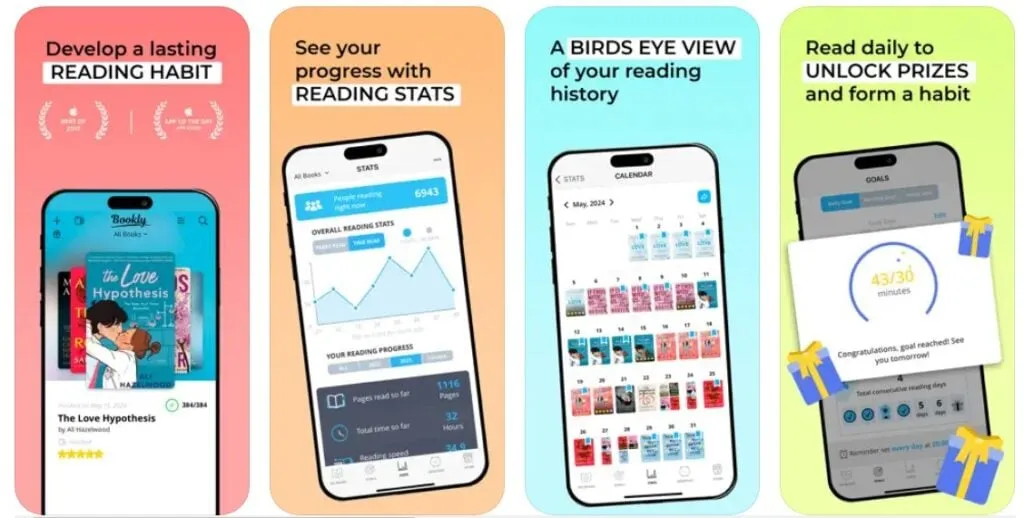
Bookly came before the current generation of habit-focused reading apps. In a category that now has a dozen credible options, it is worth noting that Bookly was the app that proved people would track their reading time with a timer rather than just logging titles. That established a blueprint that several apps, including Moth, have since refined.
The core loop is familiar: start the timer when you open your book, record your page when you stop. Bookly calculates reading speed from that input and tells you how long it will take to finish at your current pace. It also includes ambient sounds for focused reading sessions: rain, fireplace, and library noise. For readers who want an environmental nudge alongside the timer, that’s a thoughtful addition that no other app on this list offers.
The statistics are solid. Per-book infographics visualize sessions, total time, reading speed, and pages per session. Monthly and yearly reports aggregate everything. Multiple simultaneous goals are supported: daily reading minutes, monthly hours, and a yearly book count can all run in parallel, which is useful if you think about your reading in more than one dimension at once. Books sync across devices via iCloud, and a Goodreads import option, added in a 2025 update, means you can port your library without manual entry. The app also supports audiobooks and e-books alongside physical books, and a reading streaks system tracks daily consistency.
Bookly is available on iOS, Android, Mac, and Apple Watch, which is the broadest cross-device coverage of any app in this comparison. That matters for readers who pick up a different device depending on where they are, or who want a glanceable timer on their wrist.
The free tier limits you to 10 books and the app’s own privacy label shows it collects device ID for third-party advertising, which is worth knowing. The Pro subscription ($4.99 per month, $19.99 for six months, or $29.99 per year) removes those limitations and unlocks the full statistics and reporting suite, with a seven-day free trial available at sign-up.
Goodreads
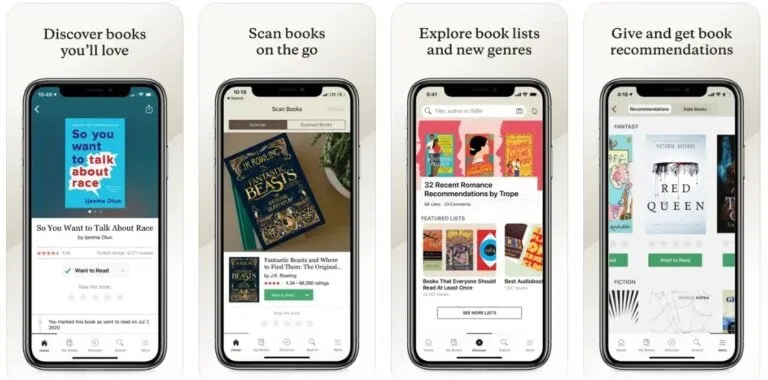
Goodreads is the only app on this list with a social graph large enough to matter. When your mother, your colleague who reads on the train, and your old university friends who started a book club are all on the same platform, that’s a real advantage that no amount of feature comparisons can dismiss. Goodreads has been around since 2007, carries 718,000 App Store ratings at 4.8 stars, and has hundreds of millions of registered accounts. The community data, the aggregated reviews, the archives on older and out-of-print books: these are things no newer tracker has replicated at the same scale.
The core tracking experience is functional. You move books between three shelves (currently reading, read, want to read), log your progress, write reviews, and rate books on a five-star scale. The annual Reading Challenge sets a book-count goal and tracks your progress. There is a barcode scanner. Friends can see your shelves and activity. The most recent iOS update, released in March 2026, finally added a DNF shelf, a feature readers had requested for years.
Amazon bought Goodreads in 2013, and the product has been slow to evolve since. Half-star ratings, standard in every other app on this list, are still absent, with multiple user reviews still requesting them. The App Store privacy label for Goodreads is by far the most extensive of any app here: contacts, search history, purchase history, physical address, and “sensitive info” all collected and linked to your identity, used for advertising, analytics, and product personalization. For readers who think carefully about what their data is used for, that’s a real consideration. An e-commerce company has genuine commercial interest in knowing what genres you read.
There is no session timer, no daily habit mechanics, and no streak tracking. Goodreads has no particular interest in whether you opened your book tonight; it’s organized around what you’ve finished, not when you read.
The honest assessment is this: if you already have an active Goodreads network and your friends are there, the social graph is real and it exists nowhere else at that scale. If you’re starting fresh with no existing social connections on the platform, the other apps here offer a more modern, more privacy-respecting, and better habit-supporting experience.
Fable
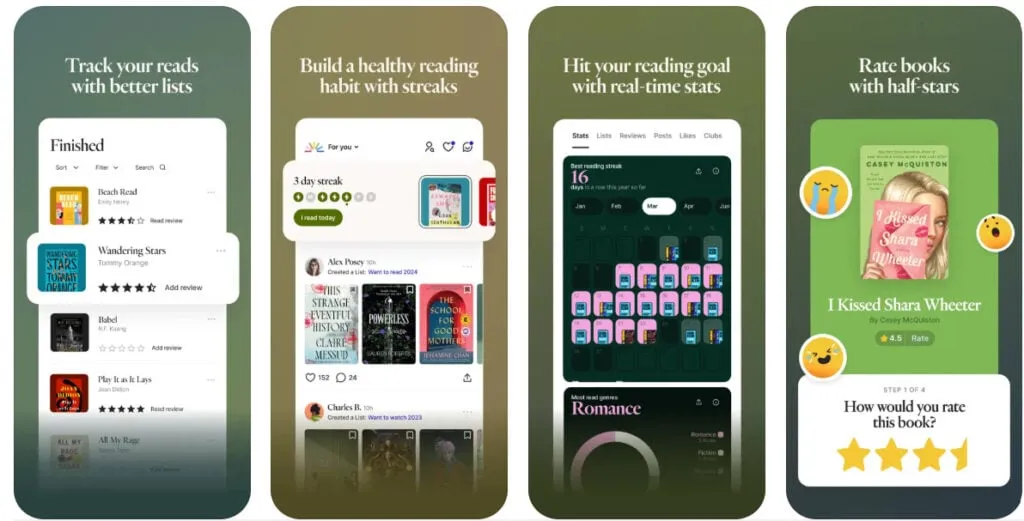
Fable is the social network in this comparison. Every other app here is, at its base, a personal reading tool. Fable is built around the premise that reading is more enjoyable, and more likely to happen consistently, when other people are doing it alongside you.
The book clubs are the reason to use it. Clubs exist for nearly every imaginable niche: specific genres, specific authors, specific fandoms, and combinations of all three. Clubs organized around Taylor Swift lyrics, around classics you’ve never read, around readers who only pick up books in a particular season. What distinguishes this from the Goodreads Groups most people abandoned years ago is that the discussions are current, the communities are specific, and the app is designed around making participation easy. There are also TV clubs alongside book clubs, which is genuinely unusual and useful if your reading life and viewing life overlap.
Tracking and habit tools are more developed than the app’s social identity might suggest. Fable has daily reading streaks, monthly goal tracking, annual reading goals, and one of the better Goodreads and Kindle import flows in the category. Stats cover most-read authors, genres, longest streak, and average book rating. Monthly Reading Wraps arrive automatically, with an annual wrap-up at year’s end. The Fable Plus subscription ($5.99 per month or $49.99 per year) also unlocks a deeper reading insights layer.
Two things worth knowing before downloading. Fable has an integrated e-reader, with over a million ebooks available to buy and a selection of free titles, so some readers use it as their primary reading app as well as their tracking tool. Reading activity is visible to followers by default, which is the right design choice for a social app and the wrong one if you want privacy. The app is also rated 18+ on the App Store, which reflects user-generated content controls rather than a content paywall.
One platform note: the App Store compatibility page lists iPhone and iPad only, with no Android version. If you need Android support, Fable is not the right choice here.
How to choose the right reading tracker for you
The fastest path to the right app is an honest answer to one question: what is actually stopping you from reading more?
You want to actually sit down and read tonight. The problem is inertia, not organization or community. You have books you want to read and you’re just not opening them. Moth is built for exactly this: a ten-minute daily goal, a streak worth protecting, and a Sunday summary that makes the habit feel real. Start with the free tier, set the goal at ten minutes, and don’t touch the settings for two weeks. If you want the math on why small daily goals outperform large sporadic ones, our pages-per-day calculator explains it clearly.
You want to understand your reading patterns. You read regularly and you’re curious about the data: what you tend to finish, how your pace varies by genre, whether your taste is narrower than you think. StoryGraph is the clear answer, and the free tier contains almost everything you’ll need. The Goodreads import takes five minutes.
You want to read with other people. The solo experience is fine but you want a community: real discussions, someone to recommend your next book, clubs organized around the specific things you care about. Fable is built for this. If the community you want is the one already around your existing contacts, Goodreads is still where most of them are.
You want the widest device coverage. Bookly runs on iPhone, Android, Mac, and Apple Watch, syncs via iCloud, and supports physical books, e-books, and audiobooks in the same library. No other app here comes close on that dimension.
The best approach is to try two of these. All five have free tiers that let you form a real opinion before committing to anything. A simpler app you open every night beats a more powerful one you abandon after two weeks.
Frequently asked questions
Which reading tracker app is best for building a reading habit on iPhone?
Moth is the most focused option for daily habit formation. The ten-minute goal, streak milestones at 7/14/30/50/100 days, Sunday weekly wraps, and shareable completion cards are all designed around consistency rather than cataloging. Bookly is the main alternative for readers who want a timer-focused experience with the widest device support, including Android, Mac, and Apple Watch.
Is Goodreads still worth using in 2026?
For readers with an established network there, yes, with caveats. The social graph is real and exists at a scale nothing else matches. The weaknesses are equally real: Amazon ownership, an extensive privacy data collection footprint, no habit mechanics, no session timer, and the absence of half-star ratings that every competing app introduced years ago. For readers starting fresh with no existing social connections on the platform, the other apps here offer a better experience overall.
Is StoryGraph free?
Most of it. The free tier includes unlimited books, tracking, streaks, mood-based statistics, reading challenges, buddy reads, book clubs, and a one-time Goodreads import. StoryGraph Plus ($4.99 per month, $49.99 per year) adds custom charts, advanced stat filters, custom wrap-up graphics, and the ability to compare library segments. Most readers find the free tier sufficient.
The honest recommendation is to try the app that matches your actual problem. Readers with an established social graph belong in Goodreads or Fable. Data readers belong in StoryGraph. Readers who want broad device coverage and a capable timer belong in Bookly. Readers who want to build the daily habit of actually opening their book belong in Moth.
Download it from the App Store or Google Play. Set the daily goal at ten minutes. See how the first week goes.