How to build a reading habit that lasts with the 66-day rule
You don't need more willpower to read more books. You need a system. Here's what the research actually says about how long a reading habit takes to stick.
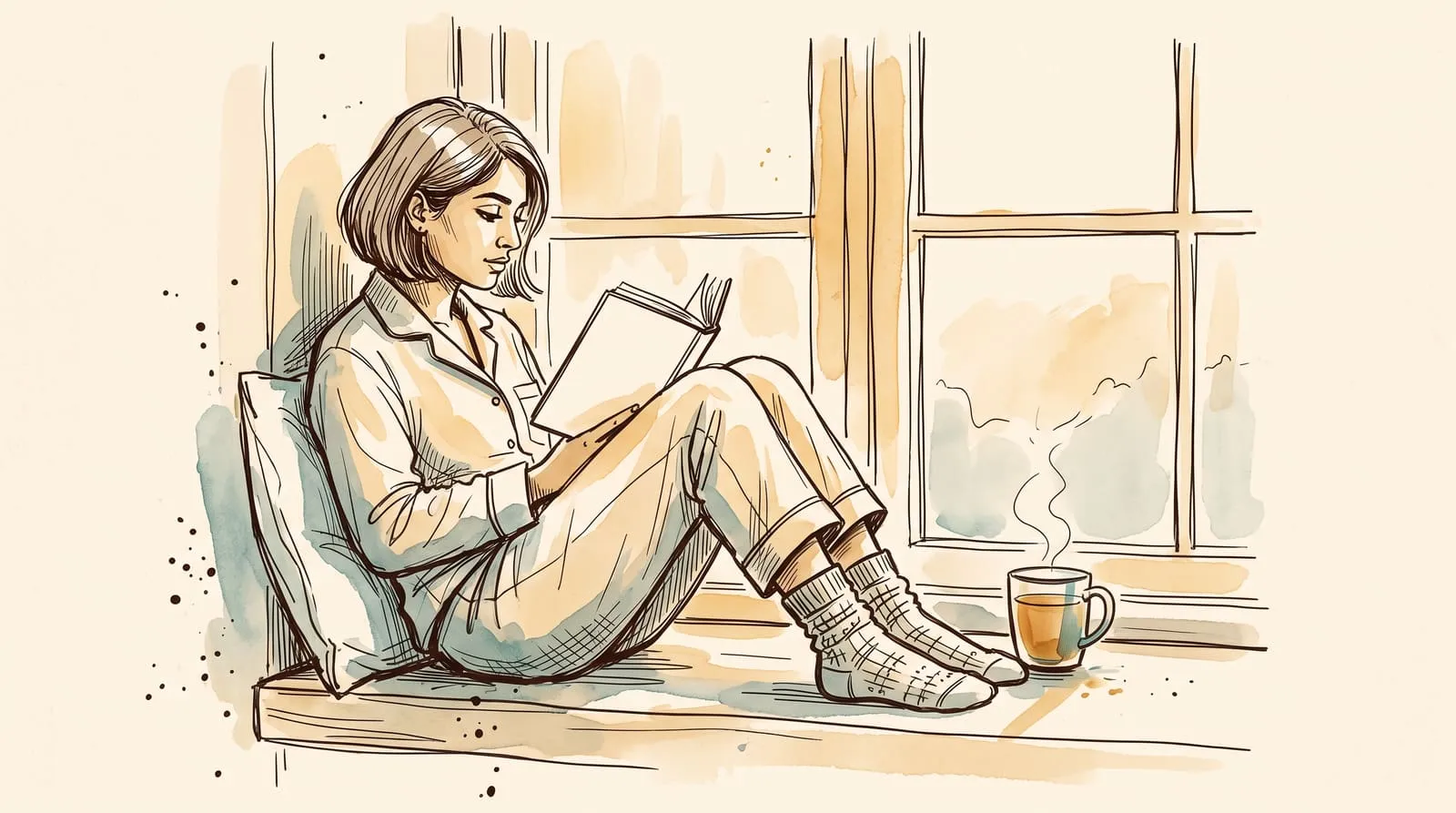
Last January I bought eleven books in three weeks and finished none of them. The stack sat on my nightstand, slowly being colonised by phone chargers and half-drunk water glasses, while my screen time quietly crept back up to embarrassing levels.
This is, I’m told, fairly typical. People who decide they want to read more usually fail, and they fail in roughly the same way: they start strong, lose momentum after a fortnight, and quietly conclude they’re “not really a reader anymore”, which is a slightly tragic thing to decide on the basis of one rough January.
Wanting to read isn’t the problem. The strategy is. Almost everything you’ve been told about how habits form is wrong, and once you replace it with what the research actually says, building a reading habit gets a lot more achievable.
The 21-day habit myth
You’ve heard that it takes 21 days to build a habit. It’s a tidy number, a popular idea, and it has roughly nothing to do with how human beings work.
The figure comes from a 1960 self-help book by a plastic surgeon named Maxwell Maltz, who noticed that his patients took about three weeks to get used to a new nose or a missing limb. That observation, decontextualised and repeated for sixty-odd years, somehow became the rule everyone quotes at the gym in January.
The actual research is more useful, and more annoying. In 2010, the health psychologist Phillippa Lally and her colleagues at University College London followed 96 people trying to form new daily behaviours: eating fruit with lunch, walking after dinner, the sort of thing that should be easy. They tracked how long it took for each behaviour to feel automatic, i.e. to happen without negotiation. 1
The average was 66 days.
The range was the more interesting bit: 18 days for the fastest learners, 254 for the slowest. Some habits stick almost immediately. Others take most of a year. And, this is the part nobody quoting the study mentions, missing the occasional day did not meaningfully damage long-term outcomes. The habit still formed. You don’t need a flawless streak. If your reading streak broke, the useful response is to read again tomorrow. You need a long runway.
That second point matters, because most of us quit the moment we miss a day.
Stop counting books
The first thing most of us do when we decide to read more is set a number. Fifty books a year. Two a month. Some round figure that looks satisfying on a spreadsheet and devastating by April.
It doesn’t work, and not quite for the reasons you’d think.
A book is the wrong unit. You can read for twenty minutes every single day for a month and finish exactly zero books, depending on the books. You can also rip through a stack of slim novels in a weekend and finish four. The number on the shelf has almost nothing to do with whether you’ve built the habit you wanted in the first place, and how long any given book actually takes to read varies enough that it shouldn’t be the thing you’re optimising for.
The same logic applies if you’re putting together a reading list for the season rather than a single book: build it around sessions, not a stack of titles. That’s the whole argument behind how to make a summer reading list you’ll actually finish.
The deeper problem is reward timing. Habits form when your brain links an action to a reward that follows it quickly. If the only way to feel like a reader is to turn the final page of something, you’re getting reinforcement maybe once a month. That isn’t enough to teach your brain anything. By the time the dopamine arrives, you’ve already talked yourself out of reading on six different evenings.
The fix is to count the thing you can actually control: did I read today, yes or no.
The reading streak trick
Once you start counting days instead of books, something useful happens. The chain on the calendar becomes the goal.
This works because of loss aversion, the well-documented quirk where losing something hurts roughly twice as much as gaining the equivalent feels good. After a fortnight of daily reading, the prospect of breaking the streak starts to feel disproportionately painful, more painful, in fact, than the friction of opening the book for ten minutes on a tired Thursday.
There’s nothing mystical about it. You’re hijacking a bias your brain came with. But it works, which is more than can be said for most productivity advice.
A few things help the streak survive contact with real life.
Set the bar embarrassingly low. Ten minutes. Five pages. One chapter, if the chapters are short. The goal isn’t to read a lot on any given day; the goal is to never have a day where reading felt like too much. If your daily target is something you’d skip when you’re tired, you’ve picked the wrong target.
Attach it to something you already do. Habits don’t form in a vacuum. They get bolted onto existing routines. After the morning coffee. Before the bedroom light goes off, which is why reading before bed is such an easy habit to build. On the commute. The existing trigger does most of the work, which is why “read more” as a free-floating intention nearly always fails.
Decide what counts before you need to know. Does an audiobook count? Does manga count as reading? Does the book you’re reading aloud to a child count? Does re-reading count? Set your own rules, but set them in advance. Not at 11pm when you’re looking for a reason to let yourself off.
A note on the six-minute stress claim
While we’re here, a small correction to a stat you’ve probably seen quoted in roughly every wellness article on the internet. There’s a widely repeated claim that reading for six minutes reduces stress by 68 percent, attributed to research at the University of Sussex. I don’t trust it and I’d suggest you don’t either.
The “study” was a small, unpublished piece of consulting work commissioned by a chocolate company in 2009. It was never peer-reviewed. The methodology has never been made public. It survives because it’s a great headline.
Reading does seem to lower stress. There is real research on that, mostly looking at sustained reading over weeks rather than single short bursts, but be wary of any habit article that leans heavily on this particular number. If a writer is willing to launder a press release as science, they’re probably willing to cut other corners too.
Why most reading apps don’t help you build the habit
Most popular reading apps treat the book as the unit. You log a book when you start it, log it again when you finish, and the app makes a small fuss at the end. That is also why a flexible system like Notion can become a beautiful catalogue without solving the behavior problem; a Notion book tracker template won’t build a reading habit on its own.
That’s a perfectly nice way to keep a record. It’s a terrible way to build a habit. There’s no daily feedback, no streak, no reward for the Tuesday night you read for eleven minutes and didn’t think it counted as anything.
What you need is a reading streak app built around the act of reading rather than the outcome of reading: minutes spent, days in a row, the small unglamorous wins that compound into a habit you stop having to think about.
This, more or less, is what Moth is.
It’s available on iPhone and Android. You start a timer when you open your book, stop it when you put it down, and the session logs automatically with pages and minutes tracked. You set a daily goal, ten minutes is the recommended starting point, and the app tracks your streak. At seven, fourteen, thirty, fifty, and a hundred days it makes a small celebration, with a shareable milestone card if that’s your thing. Every Sunday it sends a wrap-up of the week: pages, time, where the streak stands, how your reading speed has shifted. When you finish a book, you get a portrait card you can post to BookTok or Instagram Stories if you’re so inclined.
The free tier is the whole product: unlimited books, unlimited sessions, full streak tracking, the milestones, the weekly wraps. There’s no ten-book cap and no paywalled timer. It’s dark-mode-first because most reading happens at night, and the interface is intentionally sparse because the book is meant to be the point.
Ten minutes, sixty-six days
If you take one thing from this, take this:
Read for ten minutes a day, every day, for the next sixty-six days. That’s it. Not fifty books this year. Not an hour every morning. Ten minutes, every day, for a little over two months.
Around the end of the first week, you’ll feel the streak starting to pull on you. By around day thirty, opening the book stops being a decision you have to argue yourself into. Somewhere past day sixty, you’ll forget you were trying to build a habit at all. You’ll just be a person who reads, the way you’re a person who brushes their teeth, not because you decided to today but because not doing it would feel slightly wrong.
The books take care of themselves after that.
Download Moth on the App Store → or get it on Google Play →
FAQ
How long does it really take to build a reading habit? On average, about 66 days, based on Phillippa Lally’s 2010 study at University College London. The range across individuals was 18 to 254 days, so don’t be alarmed if yours lands well past the headline number. 1
What’s a realistic daily reading goal when you’re starting out? Pick something you’d still do on your worst day of the week. For most people that’s ten minutes or roughly five pages. Volume comes later. The first two months are about not breaking the chain, not about throughput.
Do reading streaks actually work? Yes, for the same reason every other streak works: loss aversion. After a couple of weeks, the streak becomes its own motivation. It’s a slightly silly psychological trick. It is also extremely effective.
Is there a free reading tracker app with streaks? Moth offers unlimited streak tracking, a built-in reading timer, daily goals, and weekly wraps on the free tier, with no book or session caps.
Footnotes
-
Lally, P., van Jaarsveld, C. H. M., Potts, H. W. W., & Wardle, J. (2010). How are habits formed: Modelling habit formation in the real world. European Journal of Social Psychology, 40(6), 998–1009. https://onlinelibrary.wiley.com/doi/abs/10.1002/ejsp.674 ↩ ↩2