Why reading before bed is the easiest reading habit to build
Most reading advice asks you to carve out a slot. Bedtime doesn't need carving. That's the whole point.
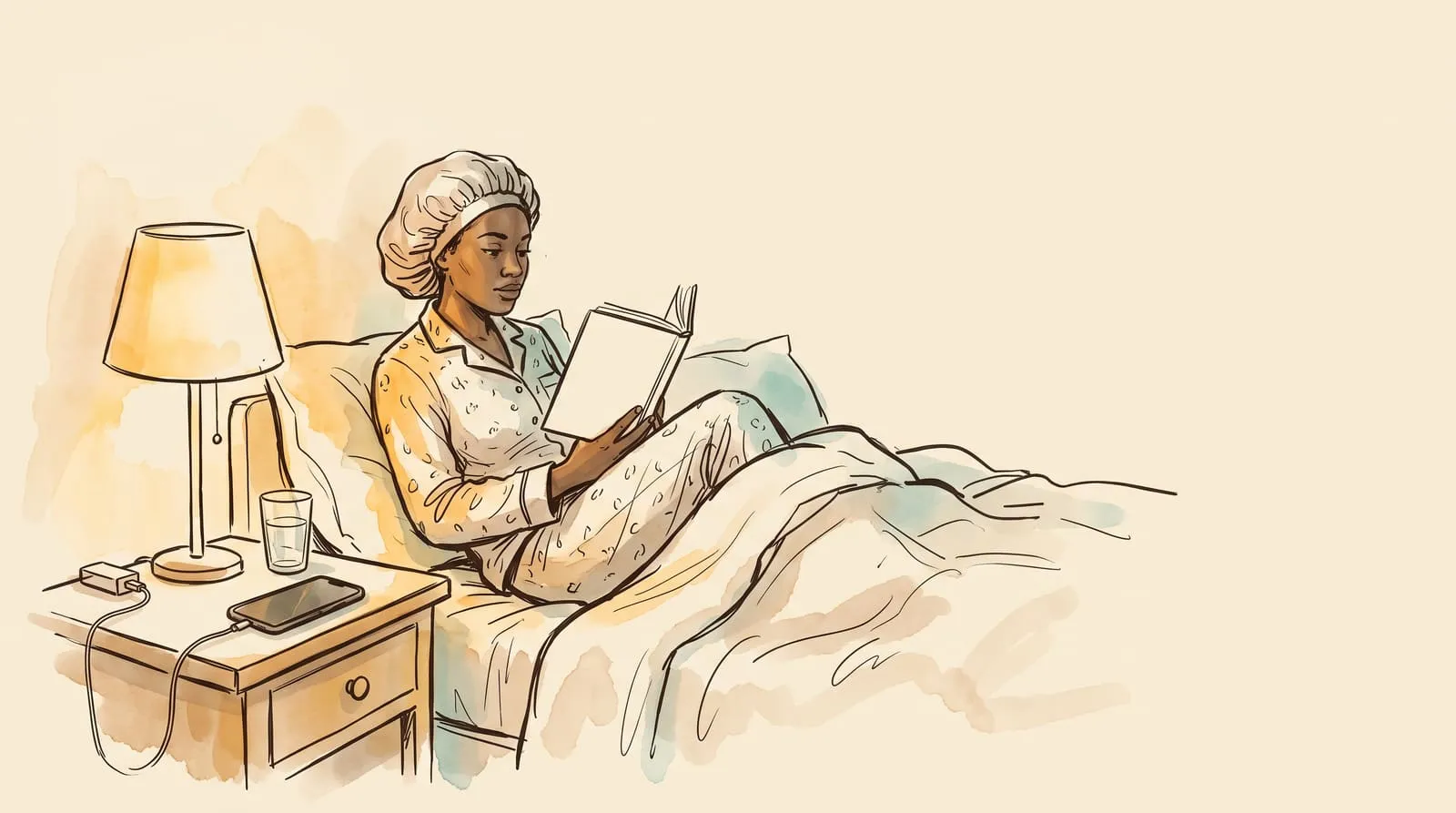
There is probably a book on your nightstand that you have been meaning to get back to. There is definitely a phone.
Finding time to read
Most advice for reading more works backwards from the goal and asks: where in your day is there unused time? The answers are predictable. Mornings before everyone wakes up. Lunch. The commute. Set a reminder. Defend the slot.
This is reasonable as far as it goes. It also fails consistently, for a reason that does not get discussed much: a carved-out reading slot has to compete with every other claim on that specific window of time. The morning slot disappears when you sleep through your alarm, or when your child needs something before school, or when you simply cannot face anything requiring attention before the first coffee. The lunch slot goes when a colleague wants to catch up. The commute slot goes on days you drive, or when you need to use the train ride to think about something else.
None of this is weakness or a failure of commitment. It is just how discrete time windows work. They are available on good days and unavailable on bad ones, and whether you read depends substantially on which kind of day it turns out to be.
Bedtime is different.
Why bedtime works when a calendar slot doesn’t
Not because it is more pleasant, and not because you are suddenly more disciplined at ten o’clock than you are at seven in the morning. Bedtime works because it is not a slot you carve out. It is a transition that happens every day regardless of what else did or did not go to plan.
Habit research points to contextual cues as the primary driver of automatic behavior: the more consistent and specific the trigger, the more reliably it activates the behavior attached to it. We’ve written about how this plays out over the longer arc of building a reading habit; the relevant point for bedtime specifically is simpler. Getting into bed happens daily, without negotiation. It sits at the end of a fixed sequence of other behaviors, which makes it an unusually stable cue. The behavioral slot it creates, the window between lying down and falling asleep, does not have to be manufactured. It just arrives.
The morning reading slot, by contrast, requires you to wake earlier than you otherwise would. Which means either going to bed earlier, trading the bedtime slot for the morning one, or accumulating sleep debt until the alarm stops working. Lunch reading requires physically putting your phone away and not checking your messages. Commute reading disappears on remote-work days. Bedtime just arrives, every night, whether you planned for it or not.
Why the phone loses more ground at night
The obvious objection: bedtime is also when most people scroll. True. But the competition between a phone and a book at night is less evenly matched than it looks.
Scrolling is built for a particular kind of attention, horizontal, rapid, stimulus-to-stimulus. During the day, when your brain is reasonably alert, that attention is genuinely satisfying. At night, tired and already lying down, it is mostly just the path of least resistance. You pick up the phone because it is there, not because it is what you actually want.
Books ask for different attention, slower and more absorbed, and once you have read a few pages the momentum begins working in your favor. You want to stay in the story. There is no phone equivalent to that pull.
There is also a more concrete argument for the switch. A 2015 study in the Proceedings of the National Academy of Sciences compared participants who read from a light-emitting device in the evening with those who read a printed book.1 The screen readers took longer to fall asleep, produced less melatonin, had a delayed circadian clock, and reported lower alertness the following morning. The study used dedicated e-readers, but the mechanism, blue light suppressing melatonin production, applies to phones. A physical book at bedtime is not just aesthetically nicer. It is the option that does not chemically work against the thing you are trying to do next. That does not settle the broader Kindle versus physical books choice, but it gives print an advantage at bedtime. The right reading light lets you keep the room dim without making the page difficult to see.
When it doesn’t work
Bedtime reading is not for everyone, and it is worth being clear about the limits.
If you fall asleep four pages in, every night, regardless of what you are reading: the habit still forms. Four pages before sleep is a reading session. It trains your brain to associate bed with opening a book, and the sessions tend to get longer once the behavior is automatic. Falling asleep is not a failed session.
If you have very young children and the window between “finally in bed” and “please just let me sleep” is approximately zero minutes: there is no useful advice here. The window comes back.
Genre matters more at bedtime than at any other time of day. A thriller that grips you hard enough to cancel sleep is counterproductive at eleven at night. The book that worked brilliantly on a weekend afternoon will keep you up two hours longer than intended, and the sleep debt that follows makes the next evening harder. Bedtime reading suits books that reward patient, unhurried progress over several nights.
If your reading habit has already collapsed rather than never quite forming, the mechanics of rebuilding are a little different from what’s described here. We covered that recently, though the entry point is the same: ten minutes tonight.
Starting tonight
The goal at the start is ten minutes, not a chapter. The habit you are building is showing up nightly, not covering ground. Session length tends to expand on its own once the behavior is consistent.
Tracking time rather than pages helps keep the pressure off. A progress bar counting down toward a book’s end introduces a small performance element that works against the relaxed quality a bedtime session should have. Moth sets the daily goal in minutes, with ten as the default. The reading timer runs while you read and stops when you put the book down, including when you fall asleep holding it. The design is dark-mode-first, warm backgrounds and amber accents, because most people open it at night. It does not feel like picking up another glowing device.
Put your phone on the charger across the room before you get into bed. Leave the book on the nightstand. The choice, when you are tired and horizontal, will make itself.
Footnotes
-
Chang, A. M., Aeschbach, D., Duffy, J. F., & Czeisler, C. A. (2015). Evening use of light-emitting eReaders negatively affects sleep, circadian timing, and next-morning alertness. Proceedings of the National Academy of Sciences, 112(4), 1232–1237. https://doi.org/10.1073/pnas.1418490112 ↩