How to get out of a reading slump (when the usual advice isn't working)
Most reading slump advice is really a book recommendation list. The actual problem is different, and so is the fix.
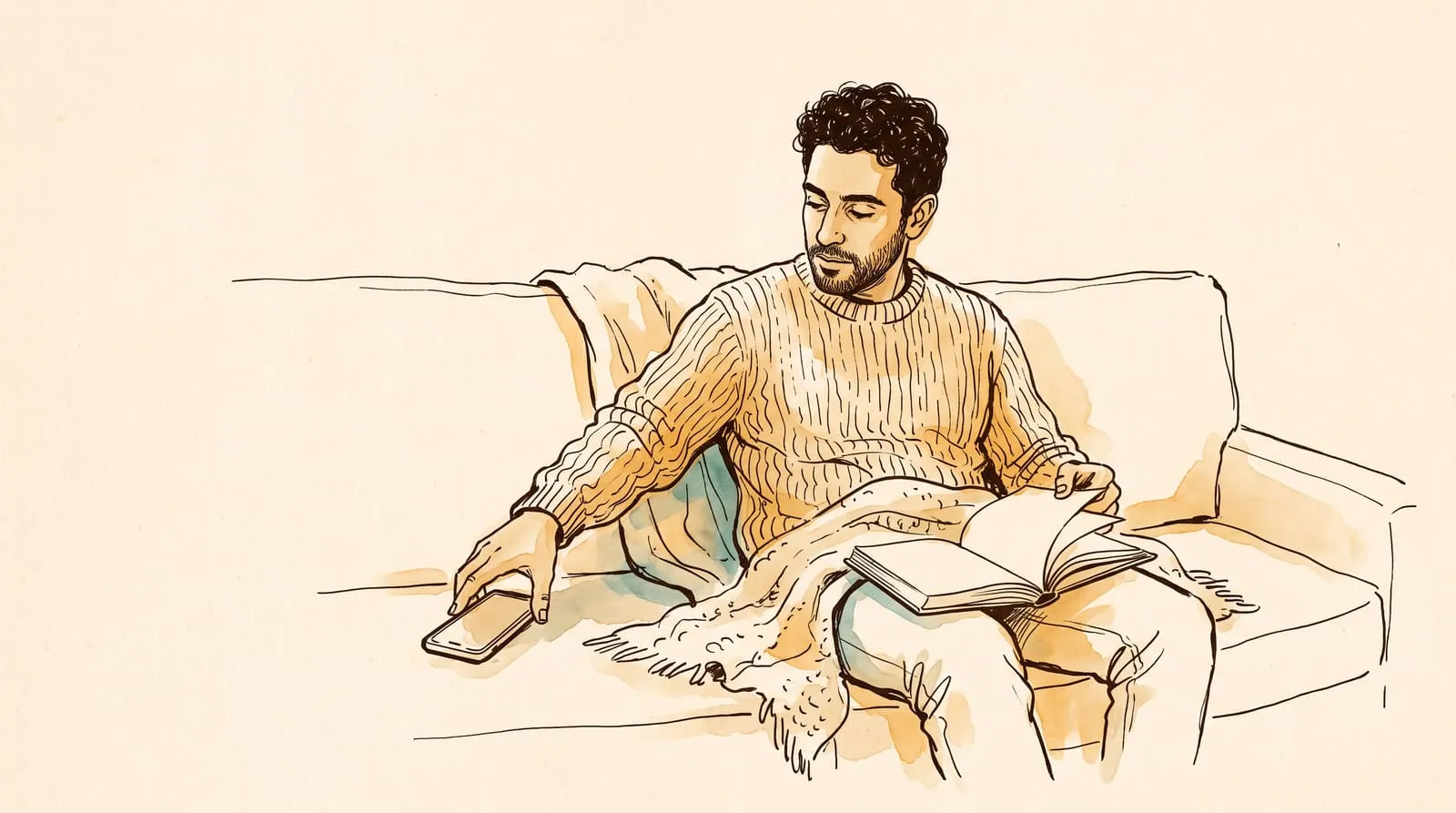
Reading slump articles are, almost without exception, book recommendation lists wearing a different hat. The headline promises a cure; the content delivers thirty titles sorted by genre. Pick something light. Try a graphic novel. Reread a favorite. The advice is not wrong, exactly. It just misses what a reading slump actually is.
The habit broke. The book didn’t.
A reading slump is not a taste problem. It is a habit problem. At some point, the daily slot you had for reading got quietly colonized by something easier: a phone, a show, the low-grade anesthesia of scrolling through nothing in particular. The habit did not announce its departure. It just stopped showing up. One skipped evening became three, became a week, became the vague guilt you now feel when you walk past your bookshelf.
The book recommendations miss this because they assume the thing blocking you is the absence of a sufficiently compelling story. Sometimes that is true. More often, the problem is that reading has stopped being automatic and started requiring a decision. Decisions, especially in the evening when you are tired and your phone is already in your hand, are easy to lose. That is why reading before bed is often the simplest reading habit to rebuild.
Why motivation is the wrong lever
The instinct when you notice a slump is to reach for bigger levers: a more exciting book, a fresh Goodreads challenge, a public commitment to 26 books this year. These approaches treat the problem as one of insufficient enthusiasm, and occasionally they work. They are also an exhausting way to restart a behavior that, before the slump, required no effort at all.
Motivation is genuinely useful for starting new habits. It is a poor substitute for restarting one that has simply been interrupted, because what interrupted it was rarely a lack of motivation. You liked reading. You probably still do. The session just stopped happening, and once it stopped, everything around it changed: the context that used to cue the behavior, the window in your evening that used to be set aside, the almost-unconscious reaching for a book instead of a phone. The machinery broke. The desire is still there.
The automatic quality of a habit degrades when the behavior stops appearing in its usual context. Restoring it is less about enthusiasm and more about repetition at a lower cost than you think is necessary. If you want to understand why that process takes the shape it does, we’ve written about it in more detail here. The part that matters for a slump is simpler: the way back runs through returning the behavior to its context, not through finding the right book.
Do less than you think is necessary
Here is where the conventional slump advice goes wrong: it focuses on raising the reward (a better book, a more gripping story). The more useful intervention is lowering the cost of re-entry.
Ten minutes. That is the target. Not a chapter. Not a satisfying narrative chunk. Not any particular number of pages. Ten minutes in the same chair, at roughly the same time you used to read, on whatever you happen to have open. The point of this period is not to have a great experience, though you probably will once you settle in. The point is to return the session to your evening as a daily event. The content of the session is almost beside the point.
This sounds too small to matter. That is precisely why it works. When re-entry costs nothing, you stop negotiating with yourself about whether it is worth sitting down tonight. You just do it.
The problem with book recommendations
The reason slump advice defaults to book recommendations is that a genuinely good book makes re-entry pleasant. If you pick up something you cannot put down, you will read it. True enough. But a book so compelling you binge it over four days is not the same thing as a reading habit. It is a reading event. Events are enjoyable. They do not necessarily train you to open a book tomorrow.
What trains you to open a book tomorrow is opening one today. The book can be slow in the middle. It can be the slightly overlong literary novel you have been meaning to finish since February. It can be a reread of something so familiar it asks almost nothing of you. The session is the unit that matters, not the story inside it.
That said: if you genuinely cannot stand what you are reading, put it down. We’ve made the case for that elsewhere, and it stands. Just do not spend three weeks deliberating over the next pick. The slump tends to live in exactly that gap.
What the rebuild actually looks like
Most reading slumps do not end in a single session of revelation. They dissolve across ten or twelve low-stakes evenings with a book in hand. At some point you will notice you are looking forward to sitting down before you have consciously registered the shift. The session length starts to creep upward on its own.
The thing that delays this is treating re-entry as a referendum on whether you are still a reader. You are. You have a gap in the record. Gaps close.
One practical thing that helps is tracking sessions rather than books finished. Most reading apps, Goodreads included, are organized around completion: shelves for finished titles, annual book-count goals, progress bars counting down pages remaining. Those features work well when things are going well. During a slump, they become a ledger of what you have failed to complete.
Moth logs reading sessions instead. The daily goal is set in minutes, not books, with ten minutes as the default starting point. The timer runs while you read and stops when you put the book down. There is no bar ticking down toward a finish line, and the sessions you have already logged stay on the record regardless of what happens next. For someone rebuilding after a slump, that shape is more useful than one oriented around finishing.
Where to start
Open whatever is on your nightstand tonight and read for ten minutes. Set no other expectations for the session. Tomorrow, open it again.
That is the plan.