The best reading streak apps in 2026
Moth, ReadStreak, Läsa, Bookly, Bookmory, and Beanstack compared on streak mechanics, timers, pricing, and who each app actually suits.

Search “reading streak app” and the results are a strange mix. A children’s ebook library that happens to share a name with a habit app. A library-and-school platform built for classroom reading logs rather than personal use. A general habit tracker that treats books the same as flossing. Somewhere in that mix are five or six apps actually built around the same core idea Moth is built around: read today, keep the number alive, don’t break the chain.
We went through the apps that show up for this search and actually use them, rather than reading their App Store descriptions and calling it a comparison. Here is what each one does with the streak mechanic, what it costs, and which one is worth your home screen.
The best reading streak apps at a glance
| Moth | ReadStreak | Läsa | Bookly | Bookmory | Beanstack | |
|---|---|---|---|---|---|---|
| Platform | iOS, Android | iOS, Android | iOS, Mac, Vision Pro | iOS, Android, Mac, Watch | iOS, Mac, Vision Pro | iOS, Android |
| Who it’s for | Individual readers building a daily habit | Friends competing on streaks together | Solo readers who want a minimal timer and goal | Cross-device readers who want a full stats suite | Readers who also want a notes and journal system | Library and school reading programs |
| Free tier | Up to 12 books, unlimited sessions and streak tracking | Free to download, streak features behind a subscription | Fully free, no in-app purchases listed | Up to 10 books, ads shown | Full tracking with ads, sync locked | Free to readers, paid by the library or school |
| Paid price | $4.99/mo or $24.99/yr | Subscription, price not published in detail | None | $4.99/mo · $19.99/6mo · $29.99/yr | $3.49/mo or $30.99/yr | N/A, institutional pricing only |
| Session timer | Yes, core feature | No | Yes, stopwatch | Yes, core feature | Yes | Yes, timer or manual log |
| Streak flexibility | Daily, milestone cards at 7/14/30/50/100 days | Daily, tied to a friend leaderboard | Daily, minimum session length applies | Daily | Daily or a set number of days per week | Daily, with badges at set thresholds |
| Social features | None | Friends and leaderboard, the app’s whole premise | None | None | None | Peer leaderboards within a library or classroom |
| Best for | Building the habit alone, with real friction removed | Accountability through friends, not solitude | A no-frills free option with almost no setup | Widest device support and per-book stats | Readers who want a journal alongside the tracker | Kids’ and community reading programs run by an institution |
Moth
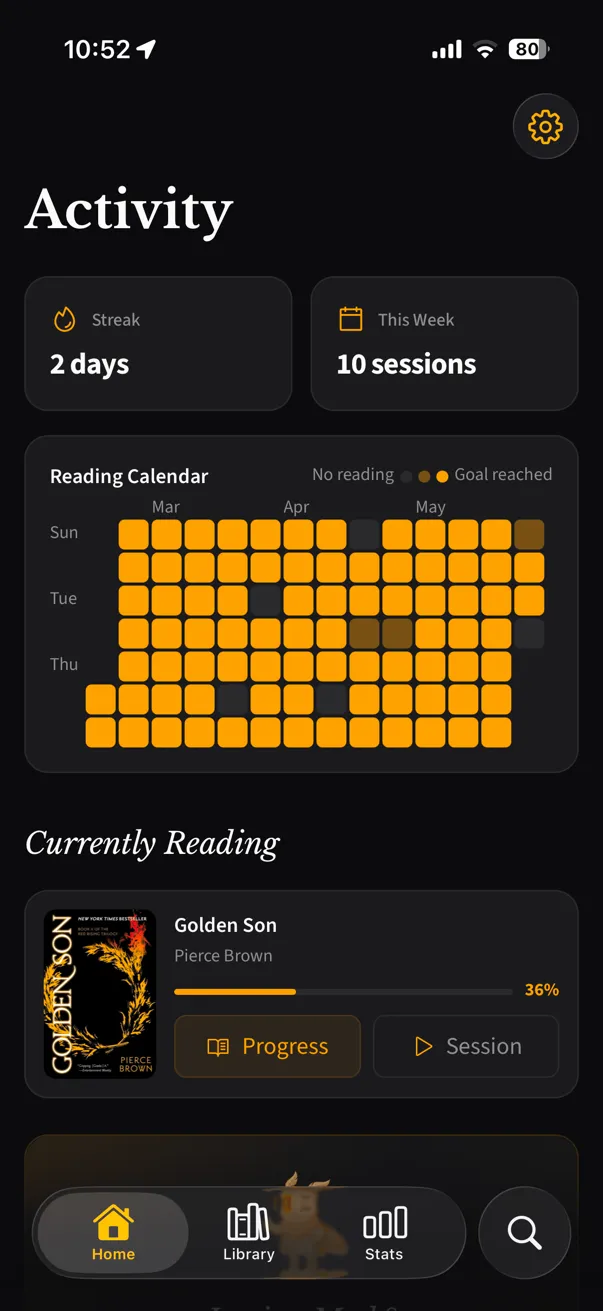
Most of the apps on this list treat the streak as one feature among several. Moth treats it as the reason the app exists. Everything else, the timer, the goal, the weekly summary, is built to keep that number alive without asking much of you on a bad night.
The mechanic is simple. Tap start when you open your book. Tap stop when you put it down. Moth logs the session, calculates your reading speed from the pages you enter, and adds the day to your streak. No manual entry, no separate step to “log” the streak after the fact. The session and the streak are the same action.
The daily goal is set in minutes or pages, and ten minutes is the recommended starting point. That number is deliberately small. A goal you can hit on your worst day is the only kind of goal that protects a streak, and a ten-minute bar is achievable after a late meeting, a bad night’s sleep, or a day that otherwise went sideways. If you want the reasoning behind why small, consistent goals beat large sporadic ones, we wrote about the research in how to build a reading habit that actually lasts.
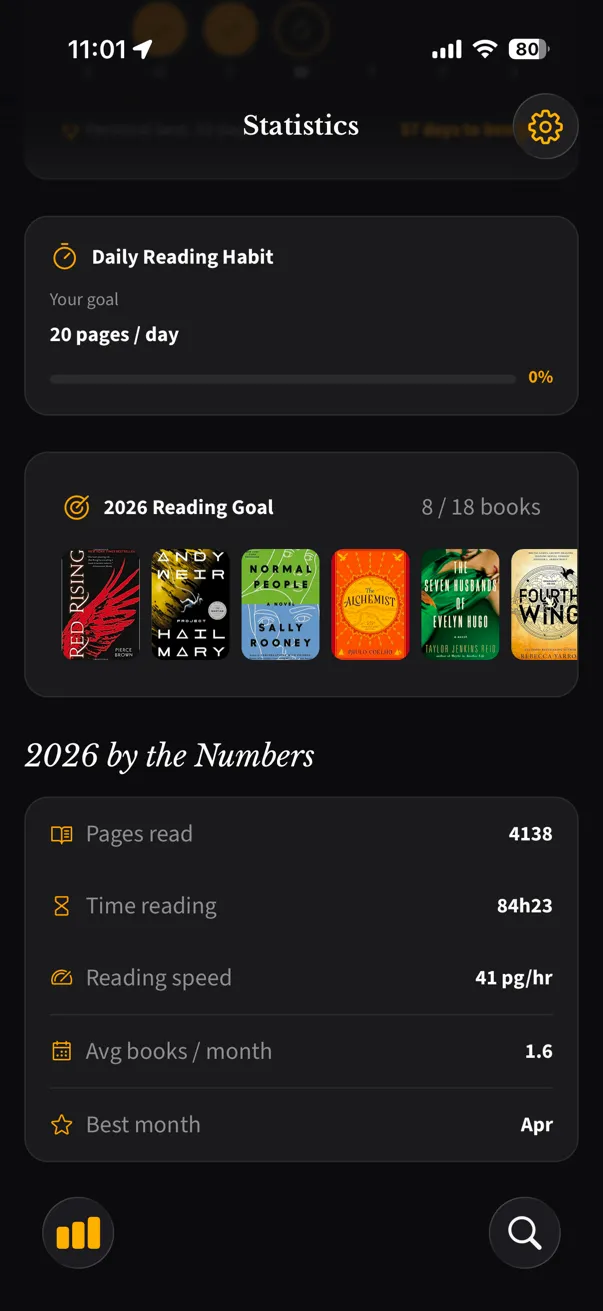
Milestones land at 7, 14, 30, 50, and 100 days, each with a small animation and a shareable card. A weekly wrap arrives every Sunday: pages read, minutes logged, streak status, and how your reading speed moved that week. When you finish a book, you get a separate 9:16 completion card with cover art and your stats, built for Instagram Stories or BookTok. Streaks and completions get different treatment because they mean different things.
We also think a lot about what happens the day a streak breaks, because it eventually will for almost everyone. The honest answer is that one missed day does very little damage to an actual habit, even though the zero on the screen makes it feel otherwise. We covered the psychology of this directly in what a broken reading streak actually means, and the short version is: read again tomorrow, and the habit is fine.
The free tier includes library tracking, unlimited sessions, the daily goal, and full streak tracking, capped at 12 books tracked at once. Premium, at 4.99 USD per month or 24.99 USD per year, adds unlimited books, full reading statistics, and yearly goal tracking. The design is dark-mode-first, on the reasoning that most streak-relevant reading happens at night, in the ten minutes before the phone goes on the nightstand.
ReadStreak
ReadStreak takes a different angle on the same problem: instead of making the streak easier to protect alone, it makes breaking it socially costly. The app’s own framing, “read together, streak together,” is a fair summary. You add friends, everyone’s streaks sit on a shared leaderboard, and the app leans on peer accountability rather than app-side nudges to keep you reading.
That is a real and different value proposition, and for readers who respond better to a group chat checking in on them than to a push notification, it is worth trying. The tradeoff is the one every social feature carries: your streak now depends partly on other people’s engagement with the app, as well as your own reading. If your friend group drifts off, the leaderboard goes quiet and the motivation built around it tends to go with it.
There is no session timer in ReadStreak’s core loop, which puts it closer to a habit-logging app than a reading-specific tool like Moth or Bookly. If you want your reading speed calculated automatically from time and pages, this isn’t built for that. If what you actually want is a reason to keep a promise to specific people, it is the most direct option on this list for that job. Note that a separate children’s ebook app shares the same name on the App Store; the one described here is the friends-and-leaderboard app at readstreak.app; the kids’ library is a separate product.
Läsa
Läsa is the minimalist on this list, and it makes a point of it. Free, no subscription, no in-app purchases, iPhone-native with Mac and Apple Vision support. If the whole idea of comparing subscription tiers is exhausting, Läsa skips that conversation entirely.
The mechanics are close to what you’d expect: a stopwatch you start and stop around a reading session, a daily time goal, and a streak that grows as you hit that goal. A built-in book calculator projects a finish date based on your current pace, a small but genuinely useful touch if you’re reading toward a specific deadline, like a book club date or the end of a reading challenge.
What it does not have is much depth beyond that. No social layer, no long-term statistics dashboard, no yearly goal tracking. For a reader who wants the absolute simplest version of a streak app and nothing else competing for attention on the screen, that’s the appeal rather than the limitation. It is also iOS and Apple-ecosystem only, with no Android version, so it is not an option if your household or reading group spans platforms.
Bookly
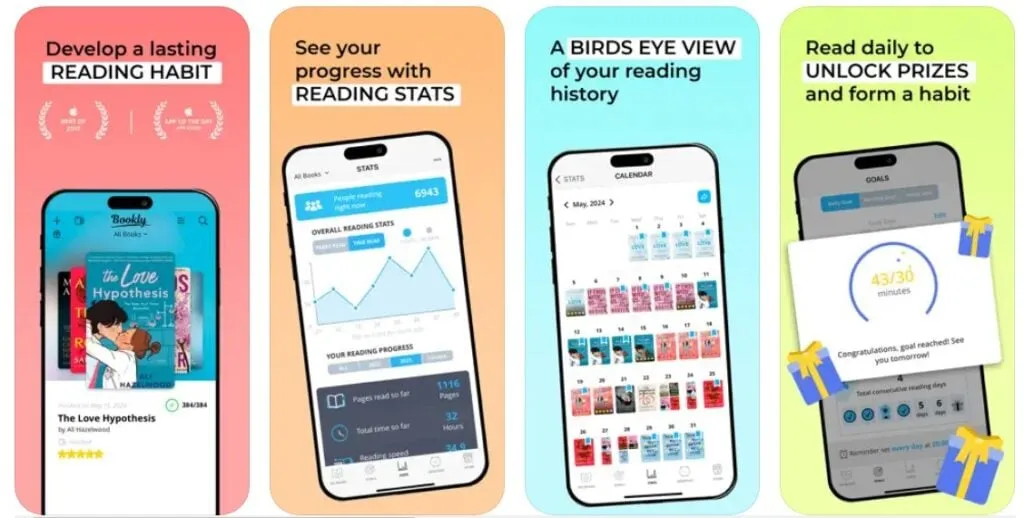
Bookly predates most of the current streak-focused apps, and it shows in how developed the rest of the app is around the timer and streak core. You start a session, log your page, and the app builds per-book infographics, monthly and yearly reports, and a reading-speed projection from your logged sessions.
The streak sits alongside several other simultaneous goals: a daily minutes target, a monthly hours target, and a yearly book count can all run at once, which suits readers who think about their reading in more than one unit. Ambient sounds, rain, fireplace, library noise, are available during sessions, a feature none of the other apps here offer.
Bookly also has the widest device reach on this list: iPhone, Android, Mac, and Apple Watch, with iCloud sync across all of them. That matters if you read on a different device depending on where you are, or want a glanceable streak count on your wrist. The free tier caps you at 10 books and shows ads, and the app’s privacy label discloses device ID collection for advertising, which is worth knowing before you commit. Pro removes both, at $4.99 a month, $19.99 for six months, or $29.99 a year.
Bookmory
Bookmory is a full book-tracking app that happens to include one of the more flexible streak systems here. Alongside the usual daily streak, it lets you set a weekly target instead, a set number of reading days per week rather than every single day, which is a meaningful option for readers who know in advance that daily reading isn’t realistic for their schedule and would rather set an honest goal than watch a streak reset every weekend.
The rest of the app leans toward readers who want a journal as much as a tracker. A built-in notes editor supports highlighting quotes and pulling text from photos via OCR, alongside the standard book search, barcode scanning, and collections. Daily and yearly reading goals sit next to the streak feature, and a December “annual rewind” summarizes the year.
The free tier is generous on tracking, unlimited books and the full streak system, but shows ads and locks cross-device sync and cloud backup behind Premium, at $3.49 a month or $30.99 a year. If a journal matters to you as much as a number that goes up, Bookmory is worth a longer look than the others here.
Beanstack
Beanstack is the odd one out on this list, and worth including precisely because it shows up in the same searches. It is not a personal habit app you download and subscribe to. It is a reading-challenge platform that libraries, schools, and districts license and run for their communities, and the mobile app is how individual readers, often children, participate in whatever challenge their library or school has set up.
Inside that structure, the streak mechanics are real: consecutive days of logged reading build a streak, badges unlock at set thresholds, including a badge specifically for a five-day streak, and leaderboards let peers within the same program see each other’s progress. Reading can be logged with a timer or added manually after the fact, and a barcode scanner speeds up adding titles.
The catch is that you can’t just download Beanstack and start a personal streak the way you can with the other five apps here. Access depends on your library or school having a Beanstack program running, and the pricing is institutional, based on population served rather than a consumer subscription. If your local library already runs a Beanstack reading challenge, it’s worth using. It is not a general substitute for a personal reading-streak app.
How to choose
You want to build the habit yourself, without relying on anyone else’s participation. Moth is built specifically for this. The ten-minute goal, the milestone cards, and the weekly wrap are all designed to keep the streak alive using nothing but your own ten minutes a night. Start on the free tier and don’t touch the settings for two weeks.
You do better with social accountability than with app notifications. ReadStreak’s whole design is built around friends and a shared leaderboard. If a group chat checking your streak would actually get you to open your book, that’s the honest reason to use it over a solo app.
You want the simplest possible free option. Läsa costs nothing and asks nothing of you beyond a stopwatch and a daily goal. It won’t give you much depth over time, but it also won’t ask you to think about a subscription.
You want the deepest stats or the widest device support. Bookly covers iPhone, Android, Mac, and Apple Watch with a fully developed reporting suite. Bookmory adds a notes and journal system alongside its tracker, plus the option of a weekly rather than daily streak target.
Your library or school already runs a reading challenge. Use Beanstack. It’s free to you, and the streak and badge system inside an existing community program tends to work well precisely because it isn’t a solo effort.
Whichever you pick, the mechanic underneath all of them is the same one worth understanding regardless of app: a broken streak is not a failed habit, just a bad day the app made visible. Read again tomorrow and the number takes care of itself.
Frequently asked questions
What is the best reading streak app for building a habit alone?
Moth is built specifically around solo habit formation: a small daily goal, milestone streak cards at 7, 14, 30, 50, and 100 days, and a weekly summary that reinforces the habit without needing anyone else’s participation. Läsa is the simplest free alternative if you want the same basic mechanic with fewer features.
Are reading streak apps with friends better than solo ones?
It depends on what motivates you. Apps like ReadStreak use peer accountability, a shared leaderboard where your friends can see if your streak breaks. That works well for readers who respond to social pressure, but the streak’s momentum depends partly on the group staying engaged, which is a real limitation solo apps don’t have.
Does missing one day reset a reading habit, not just a streak number?
No. Habit formation research shows automaticity builds gradually over weeks and doesn’t unravel from a single missed day. The streak counter treats a missed day the same as a month-long gap, which is the mechanic’s real flaw. We go through the research in detail in what a broken reading streak actually means.
Is there a free reading streak app with no subscription?
Läsa is fully free with no in-app purchases. Moth and Bookmory both offer full streak tracking on their free tiers, with subscriptions gating deeper stats or cross-device sync rather than the streak mechanic itself.
Pick the one that matches how you actually get things done instead of the one with the most features. Set a goal small enough to hit tonight, and see where the number is in a week.