Little free libraries: what those tiny book boxes teach us about reading culture
What is a little free library, where did the book boxes come from, and how to actually use one to read more. A closer look at the movement.
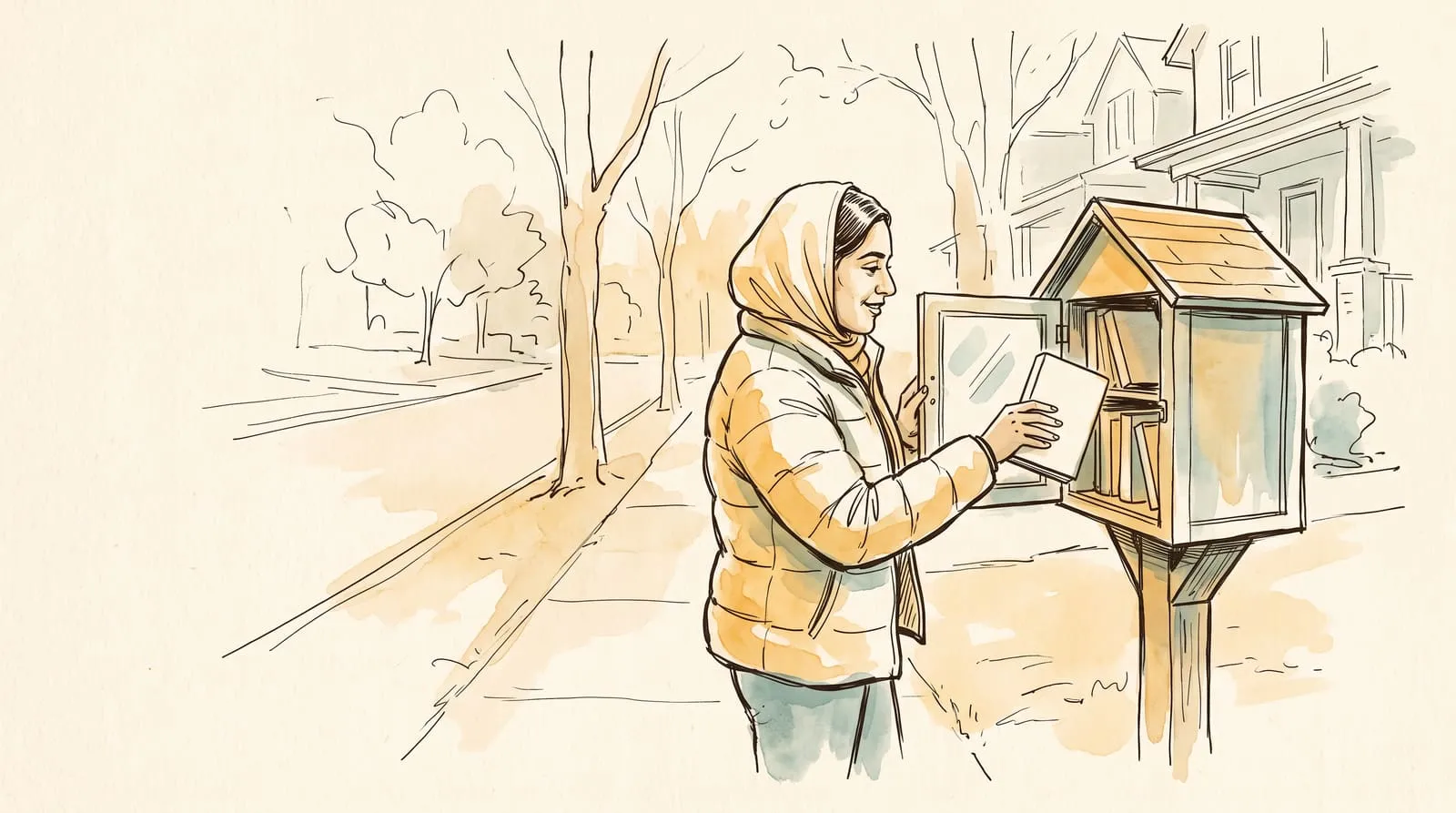
There is a plywood box on a post two streets from my apartment, painted the color of a robin’s egg, with a glass door and a latch that sticks. Inside, on any given week: three thrillers, a diet book from 2011, someone’s water-warped copy of The Alchemist, and occasionally something genuinely good. It is a little free library, one of more than 200,000 registered around the world,1 and I have walked past it almost daily for two years. It has changed how I think about reading culture more than any statistic I have seen on the subject.
What is a little free library?
A little free library is a small, weatherproof box of books mounted in a public-facing spot, usually a front yard, a park, or outside a café, where anyone can take a book or leave one at no cost. There is no membership, no due date, and no record of who took what. Most boxes are maintained by a volunteer called a steward, who keeps the box stocked and in decent repair. Many are registered with the Little Free Library organization, a nonprofit founded in Wisconsin in 2009, which charters boxes the way scouting organizations charter troops; as of 2025 it counts over 200,000 registered libraries in 128 countries.1 The exchange runs entirely on an honor system. You can take a book without leaving one, keep it forever, pass it on, or return it months later, and nobody will ever ask.
Who invented the little free library?
Todd Bol built the first little free library in 2009 in Hudson, Wisconsin, as a tribute to his mother, a schoolteacher who had loved reading and had recently died. It was a model of a one-room schoolhouse, made of scrap wood, filled with books, and mounted on a post in his front yard. Neighbors kept stopping. He built more boxes and gave them away. A partner, Rick Brooks, helped him turn the idea into an organization, and the two set themselves a cheeky benchmark: build more libraries than Andrew Carnegie, whose philanthropy had funded 2,509 of them. They passed Carnegie’s number in August 2012, the same year the organization became a registered nonprofit. Bol died in 2018, by which point there were more than 75,000 boxes.1 The count has since more than doubled.
That origin explains the movement’s character. Bol built a memorial, and a few hundred thousand people recognized something in it. At a glance:
- First box: 2009, Hudson, Wisconsin, built by Todd Bol
- Registered nonprofit: 2012
- Registered libraries: over 200,000 as of 2025
- Countries: 128
- Cost to the reader: nothing
Do little free libraries actually expand access to books?
Mostly, no. Mapping research shows the boxes cluster in affluent neighborhoods that already have good access to books; their real value lies elsewhere. The story usually told about these boxes is that they expand access to books. It is a warm story, and there is a real problem underneath it: researchers Susan Neuman and Naomi Moland walked six urban neighborhoods street by street and found what they called book deserts, high-poverty areas where children’s books were almost impossible to buy at any price, with access to print declining sharply as neighborhood income fell.2
The uncomfortable finding is that little free libraries mostly do not stand in book deserts. When librarian Jane Schmidt and geographer Jordan Hale mapped the boxes across Toronto, they found them concentrated in affluent, gentrified neighborhoods, usually within easy reach of a well-stocked public library branch.3 The boxes cluster where books already are. If you have ever browsed one, this will not surprise you: the typical inventory is what a comfortable, bookish household sheds, which is why every box in existence seems to contain a Dan Brown novel and somebody’s discarded copy of Eat, Pray, Love.
So if the boxes are not solving book access, what are they doing? This is where I think the critics, who are right on the geography, read the movement too narrowly. Judged as literacy infrastructure, a little free library is a rounding error next to an actual public library. Judged as evidence about reading culture, it is one of the most interesting data points we have.
What do little free libraries teach us about reading culture?
Consider what a little free library does that a public library, for all its overwhelming superiority, does not.
It makes reading visible. A box of books on a residential street is a small public declaration that people here read, the same way a basketball hoop over a garage says people here play. Reading is a private act with almost no street presence, which is part of why lapsed readers so easily conclude that nobody reads anymore. Every box is a counterexample you walk past on the way to get milk. The growth of silent book clubs over the same period points at the same hunger: readers want the solitary act to have some shared, visible dimension again.
It removes every barrier except curiosity. No card, no account, no due date, no late fee, no librarian watching, no algorithm inferring your taste. The entire transaction is: you were walking, a spine caught your eye, now the book is yours. For a certain kind of hesitant reader, someone who feels vaguely that libraries and bookstores are for other people, that frictionlessness is the whole game.
The whole system runs on surplus and trust. Two hundred thousand boxes stocked by volunteers, refilled by strangers, and almost never emptied by theft, because stealing from a box labeled “take a book” is a logical impossibility. The system works because more people want to give books away than want to hoard them, which is a hopeful fact about readers that no circulation statistic captures.
Taken together, the boxes show what keeps reading culture alive at street level: visibility, zero friction, and no gatekeeping. Those happen to be the same three things a personal reading habit needs.
How to use a little free library to read more
If there is a box near you, it can do real work for your reading life, provided you use it deliberately rather than sentimentally.
Put it on a route you already walk
A box you pass on the way to the train is a twice-daily prompt that costs nothing, the cue-attachment mechanism psychologists call an implementation intention: deciding in advance that an existing part of your day will trigger the new behavior.4 Checking the box takes 30 seconds. Most days it will offer nothing. The checking itself is the point: it keeps books in your field of vision on the days your phone is winning. That prompt works best feeding an existing routine, and if you do not have one yet, start with building a reading habit that lasts and let the box be one of its triggers.
Take books you would never buy
A bookstore purchase carries obligation; a 0-dollar impulse grab carries none. This makes the box the perfect place to test genres outside your lane, because abandoning a book that is not working costs you nothing when the book cost you nothing. Some of the best reading years start with a book someone else gave up on.
Use it as an exit for finished books
A finished book on your shelf is inert. The same book in the box is bait for the next reader, and clearing it makes room for the unread books you actually intend to get to. Dropping off a book you loved, knowing a stranger will find it, is also a quiet pleasure that never wears out.
Steward one if there is no box near you
Stewarding a box is less romantic than it sounds: a waterproof box, a post, a starter stack of books, and a promise to glance at it weekly. The organization sells kits, but plenty of boxes are scrap wood and a hinge, which is how the first one was built.
Where Moth fits
Moth exists for the part of the reading life the box cannot see: what happens after the book leaves the box. The free tier tracks up to 12 books with unlimited reading sessions, a daily goal, and streak tracking, so a paperback grabbed on a Tuesday walk becomes logged pages by Tuesday night. The timer is tap to start, tap to stop, and it does not care whether the book cost 30 dollars or came out of a plywood box with a sticky latch. A little free library keeps books moving through a neighborhood. A tracker keeps them moving through you. The two solve different halves of the same problem, which is that most books, everywhere, sit unread.
Tonight
Look up the nearest box on the Little Free Library world map, or just recall the one you already walk past. Next time you pass it, open the door. Take the strangest thing in there. And bring the book you finished last month, the one that is just sitting on your shelf, so the box teaches someone else what it taught you: that somebody around here still reads.
Footnotes
-
Little Free Library. The History of Little Free Library. Littlefreelibrary.org, retrieved 2026. ↩ ↩2 ↩3
-
Neuman, S. B., & Moland, N. (2016). Book Deserts: The Consequences of Income Segregation on Children’s Access to Print. Urban Education, 54(1), 126-147. ↩
-
Schmidt, J., & Hale, J. (2017). Little Free Libraries®: Interrogating the impact of the branded book exchange. Journal of Radical Librarianship, 3, 14-41. ↩
-
Gollwitzer, P. M. (1999). Implementation intentions: Strong effects of simple plans. American Psychologist, 54(7), 493-503. ↩