Reading with ADHD: strategies that actually work
Focus doesn't work like advice columns assume. Here's what actually helps an ADHD brain get through a book, and why willpower isn't it.
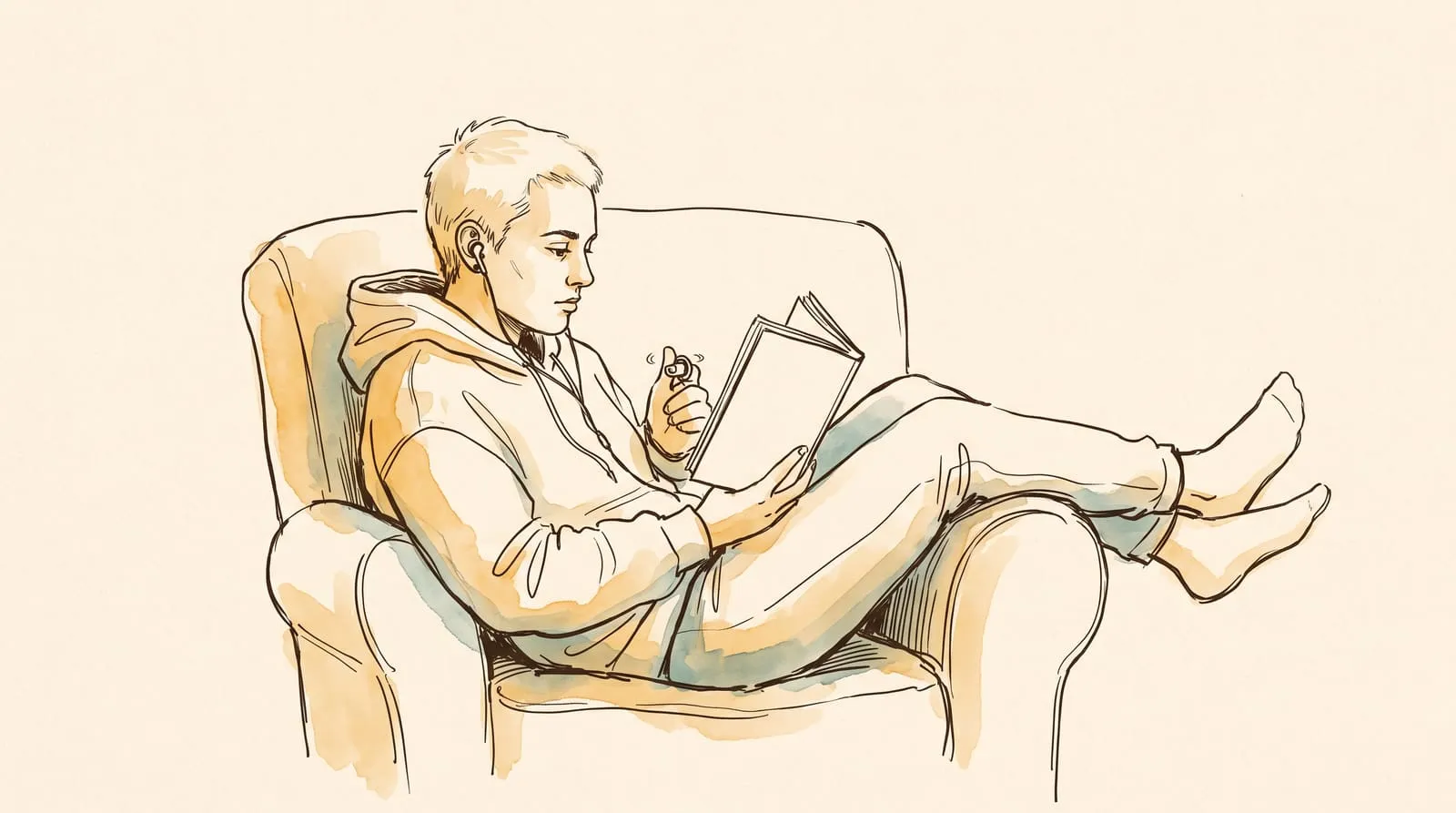
I have read the same paragraph of the same book nine times in one sitting. Not because the writing was bad. Because somewhere around the third sentence my brain had already left to think about an email, a snack, and a mildly embarrassing thing I said in 2019, and I kept “reading” the words without any of them landing. This is a fairly normal Tuesday for a lot of ADHD readers, and almost none of the standard reading advice accounts for it.
Most advice on focus assumes the reader’s attention is a dial: turn up the willpower, turn down the distraction, and the words start sticking. For an ADHD brain, attention doesn’t work like a dial. It works more like a spotlight with a mind of its own, one that dims for anything moderately interesting and floods for anything more interesting than what’s in front of it. Telling that brain to “just focus” is like telling someone with a bad knee to just walk normally: technically an instruction, but useless as guidance.
Why “just concentrate” doesn’t work
ADHD is, at its core, a difference in executive function: the systems that regulate attention, working memory, and the ability to inhibit a more interesting impulse in favor of a less interesting one. A book competing against a phone, a browser tab, or your own internal monologue is competing against things engineered or evolved to win. Willpower is a poor tool against that mismatch, because willpower depends on the same executive function that’s already running short.
This is why the standard fixes (find a quieter room, turn off notifications, try harder) tend to underperform for ADHD readers specifically. They treat the environment as the problem. Often the actual problem is that reading, as an activity, provides very little immediate feedback. No dopamine hit at the end of a sentence. No streak, no ping, no like. A brain that runs on stronger, faster reward signals will drift toward whatever supplies one, and a book rarely does, at least not quickly enough to compete.
None of that means reading is off the table. It means the fix has to work with the ADHD brain’s actual wiring rather than against it.
Strategies that work with the wiring, not against it
Shrink the session until it’s boring to fail. Ten minutes is a realistic starting target, not because it’s a magic number but because it’s short enough that starting doesn’t require a negotiation with yourself. This is the same logic behind building a reading habit that actually lasts: the goal has to be small enough that skipping it feels more effortful than doing it. For an ADHD brain, “read a chapter” is a plan. “Read for ten minutes” is closer to a fact you can just let happen.
Let your hands do something else. There’s real research behind this, and it runs against the intuition that fidgeting is the enemy of focus. A study by Sarver and colleagues found that children with ADHD performed better on demanding working-memory tasks when they were moving, not despite the movement but because of it.1 The movement isn’t a distraction competing with the task. For some ADHD brains it’s part of how the task gets done. A stress ball, a spinner ring, pacing while you read a page standing up: none of it needs to be justified as harmless, since it may genuinely be helping you get through the page.
Try reading and listening at once. Pairing an audiobook with the physical or ebook page, so your eyes and ears are getting the same sentence at the same time, is one of the more consistently reported strategies among ADHD readers, and it’s not just a hunch. Research comparing reading, listening, and reading-plus-listening found comprehension across all three formats was roughly equivalent, meaning the dual approach doesn’t cost you anything on understanding.2 What it does provide is a second channel pulling your attention back to the page every time your eyes wander off the line, which for a lot of ADHD readers is most of what’s actually needed. If you want to test this without committing to a physical stack of books, most major audiobook apps let you sync narration speed to something a bit faster than natural conversation, which some readers find easier to lock onto than a slower narrator.
Read in short, externally timed bursts. A kitchen timer, a phone timer, anything that turns “keep reading” into “read until the timer goes off” removes a decision point. The decision to keep going is where attention leaks out. Removing it, even via something as blunt as a countdown, tends to help more than it should.
Pick books that reward you quickly. Slow, literary, interiority-heavy novels are a rough fit for a brain that needs feedback sooner than page 140. That’s a mismatch between the pacing of the book and the reward timeline the reader needs, nothing more. Genre fiction with a strong hook, shorter chapters, or higher stakes per page tends to be a kinder starting point, at least until reading itself becomes more automatic.
Read standing up, or somewhere slightly uncomfortable. This sounds like a joke and isn’t. Total physical comfort, in a warm bed, under a blanket, is a fantastic setup for sleep and a mediocre one for staying alert enough to track a sentence. A slightly less cozy setup, a hard chair, a spot with a bit of ambient noise, can keep just enough alertness in the system to keep the words registering.
What doesn’t help, and one thing that gets overhyped
Total silence and a completely bare room are the advice you’ll see most often, and for a lot of ADHD readers they backfire. Total silence leaves more room for internal noise, the wandering thoughts that fill a vacuum faster than external distraction ever did. A little consistent background sound, not a podcast with words competing for the same channel as your book, but something like low instrumental music or rain, often works better than dead quiet.
Bionic reading, the formatting trick that bolds the first few letters of each word, gets recommended constantly in ADHD reading spaces, and the enthusiasm is a bit ahead of the evidence. A controlled 2024 study testing the format found no measurable improvement in reading speed or comprehension compared to normal text.3 Some readers report it feels easier, and subjective ease matters, so testing it on yourself for a chapter or two is a reasonable way to settle the question.
When the problem isn’t focus at all
Worth saying plainly: some reading difficulty that gets attributed to ADHD is actually a co-occurring reading difference, most commonly dyslexia, which shows up alongside ADHD often enough that it’s worth ruling out rather than assuming every stuck sentence is an attention problem. If the trouble is decoding the words themselves rather than staying with them once decoded, the fix looks different, and it’s worth mentioning to whoever manages your care rather than solving for with a timer.
And if none of the above lands and you’re just not enjoying the book, that’s a separate problem with a separate fix. Not every stalled book is an attention problem; sometimes it’s just the wrong book, and the honest move is to put it down rather than force ten more minutes of a story that isn’t working.
Where Moth fits
Most reading apps are built around finishing books, which is exactly the wrong unit for a brain that needs quick, frequent feedback. Moth tracks minutes instead: you start a timer when you open the book, stop it when you close it, and the app logs the session regardless of whether you finished a page or a chapter. The daily goal defaults to ten minutes, which lines up with the shrink-the-session approach above rather than fighting it. There’s a streak, there’s a weekly summary, and none of it requires you to have finished anything to count as a win.
It’s free to start, with unlimited sessions at the entry tier, available on iPhone and Android.
Tonight
Set a timer for ten minutes. Pick up whatever book has the most forward momentum, not the one you feel you should be reading. Sit somewhere slightly less comfortable than your bed. When the timer goes off, stop, even mid-sentence. Do it again tomorrow.
FAQ
Why is it so hard to focus when reading with ADHD? Reading provides very little immediate feedback compared to a phone or a screen, and ADHD involves executive function differences that make weaker, slower reward signals harder to compete for attention. The mismatch is between how the brain seeks reward and how a book delivers it, which willpower alone can’t close.
Does listening to an audiobook while reading the text help ADHD readers? Often, yes. Research comparing reading, listening, and dual-modality approaches found comprehension was roughly equivalent across all three, so pairing narration with the page costs nothing on understanding while giving a second attention anchor.2
Is fidgeting while reading actually helpful, or just a distraction? For many people with ADHD, movement supports working memory rather than draining it. A study on children with ADHD found performance on demanding cognitive tasks improved when movement was allowed rather than suppressed.1
Does bionic reading actually work for ADHD? The evidence so far doesn’t show a measurable improvement in speed or comprehension from bionic-style bolded text, though some readers report it feels easier, so trying it yourself is more reliable than taking anyone’s word for it.
Footnotes
-
Sarver, D. E., Rapport, M. D., Kofler, M. J., Raiker, J. S., & Friedman, L. M. (2015). Hyperactivity in attention-deficit/hyperactivity disorder (ADHD): Impairing deficit or compensatory behavior? Journal of Abnormal Child Psychology, 43(7), 1219-1232. https://link.springer.com/article/10.1007/s10802-015-0011-1 ↩ ↩2
-
Rogowsky, B. A., Calhoun, B. M., & Tallal, P. (2016). Does modality matter? The effects of reading, listening, and dual modality on comprehension. SAGE Open, 6(3). https://journals.sagepub.com/doi/10.1177/2158244016669550 ↩ ↩2
-
Snell, J. (2024). No, Bionic Reading does not work. Acta Psychologica, 247, 104302. https://www.sciencedirect.com/science/article/pii/S0001691824001811 ↩